Ophelia Lounge Chair
 Inspired by Millais’ “Ophelia,” this lounge chair drapes a laminated seat over a cardboard egg crate, cradling the body in a surrendered, end-of-day recline.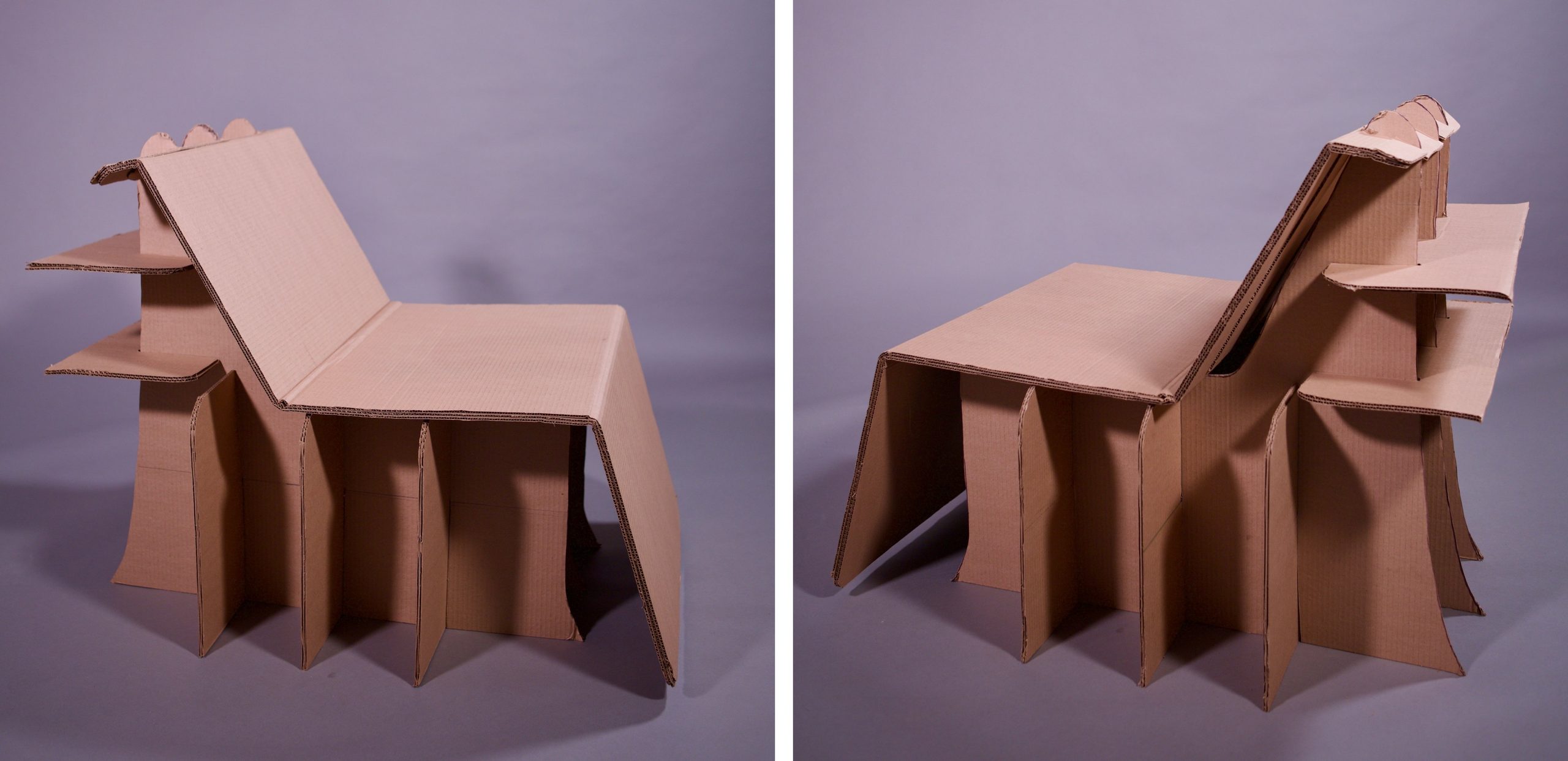 CONCEPTOphelia grew out of a deeply personal place. I wanted to design a lounge chair that allows for complete decompression at the end of the day. Living in the city can be overwhelming, and everything takes a toll. At the end of the day, I need a place to sit in stillness, where my body can rest while my mind lets go. PRECEDENTS
MATERIAL MANIPULATION
DESIGN DEVELOPMENT STUDIES Ophelia took four full-scale prototypes in under two weeks, each one testing what the last one taught. The first, made from moving boxes reused from a Seattle-to-New York move, jointed its pieces together organically with no egg-crate structure, and it failed completely. The second went back to the original concept to test early structure and ergonomics. The third introduced ribs shaped like rolling hills, with flared edges and a tall backrest. The final build laminates three sheets into a rounded seat whose back folds into the ribs, locking the chair into one connected unit. DESIGN SOLUTION To design Ophelia, I started with a feeling rather than a form: the need for a place to fully decompress at the end of the day. Inspired by John Everett Millais’ “Ophelia,” in which the heroine floats held entirely by the water beneath her, I set out to design a lounge chair whose structure does the work so the body doesn’t have to. I studied lounge posture to set the key dimensions, a 17″ seat height, 18″ seat depth and a 105° to 120° back angle, so the body could settle into a supported recline. Through material experiments, I learned that slotting cardboard ribs at right angles creates a self-supporting egg-crate base. I then built four full-scale prototypes in under two weeks. The first, made from reused moving boxes with no egg-crate structure, failed completely, and each version after that tested what the last one taught. Drawing on the Eameses’ LCW, the final build uses a laminated seat that drapes over the ribs and folds into them, locking the chair into one connected unit.  Ophelia in situ |

THE TREFOIL CHAIR
The Trefoil Task Chair concept is a compact easily assembled task chair created by slotting, braiding, laminating, and folding cardboard that changes what sitting is for you CONCEPT The Trefoil is a task chair that’s designed to make you get
THE TREFOIL CHAIR
The Trefoil Task Chair concept is a compact easily assembled task chair created by slotting, braiding, laminating, and folding cardboard that changes what sitting is for you CONCEPT The Trefoil is a task chair that’s designed to make you get

The Fidget Chair
The Fidget Chair is a task chair designed to help users cope with stress and allows movement to stay focus while reading, working or simply relaxing. CONCEPT My intent was to design a versatile chair that helps users with ADHD
The Fidget Chair
The Fidget Chair is a task chair designed to help users cope with stress and allows movement to stay focus while reading, working or simply relaxing. CONCEPT My intent was to design a versatile chair that helps users with ADHD

The Fortune Chair
The Fortune Chair is designed as a comfortable reading and lounging chair that encourages users to relax. CONCEPT I wanted to create a chair that felt just as comfortable for reading and lounging as it did for sitting upright. I
The Fortune Chair
The Fortune Chair is designed as a comfortable reading and lounging chair that encourages users to relax. CONCEPT I wanted to create a chair that felt just as comfortable for reading and lounging as it did for sitting upright. I

Reclined Reflection
Reclined Reflection is a meditative space that utilizes the reflection of the sunlight on water to create caustics for people to observe and experience serenity. We were asked to create a spatial installation near the waterfront next to Chelsea Piers.
Reclined Reflection
Reclined Reflection is a meditative space that utilizes the reflection of the sunlight on water to create caustics for people to observe and experience serenity. We were asked to create a spatial installation near the waterfront next to Chelsea Piers.

Sound Portal
Sound Portal is an immersive sound space that useswind to play strings within a wooden resonatingchamber while simultaneously cooling inhabitants. PhenomenaWIND can be used as a medium to feel an experienceand ENTROPY brings us awareness to oursurroundings to be more
Sound Portal
Sound Portal is an immersive sound space that useswind to play strings within a wooden resonatingchamber while simultaneously cooling inhabitants. PhenomenaWIND can be used as a medium to feel an experienceand ENTROPY brings us awareness to oursurroundings to be more

The Sunpath Pavilion
The Sunpath Pavilion is a small playground for relaxation that measures time and creates a dynamic effect of sunlight by tuning color filters and edges to the angles of sunlight throughout the day. . Phenomena: Analemma & The solar altitude
The Sunpath Pavilion
The Sunpath Pavilion is a small playground for relaxation that measures time and creates a dynamic effect of sunlight by tuning color filters and edges to the angles of sunlight throughout the day. . Phenomena: Analemma & The solar altitude

Maze Cube
As you step into Maze Cube , the mirrors reflect every angle of you, revealing your entire self without concealment. What you see is not just yourself but countless overlapping images of you. In this “maze” of mirrors, every step
Maze Cube
As you step into Maze Cube , the mirrors reflect every angle of you, revealing your entire self without concealment. What you see is not just yourself but countless overlapping images of you. In this “maze” of mirrors, every step

The Hudson Echo
The Hudson Echo infuses the natural acoustics of the Hudson River through its form. Its concrete exterior shell extends into the river to channel its ambient sound up throughout the interior space. Its shell and theater shaped rows help create
The Hudson Echo
The Hudson Echo infuses the natural acoustics of the Hudson River through its form. Its concrete exterior shell extends into the river to channel its ambient sound up throughout the interior space. Its shell and theater shaped rows help create

Boiling Point
A space for meditative mindfulness, physical wellness, and for immersive contemplation on the existential threat of climate change. The project uses cedar wood heated by a glass dome evaporating water to create a hot, humid, steam-room like experience on the
Boiling Point
A space for meditative mindfulness, physical wellness, and for immersive contemplation on the existential threat of climate change. The project uses cedar wood heated by a glass dome evaporating water to create a hot, humid, steam-room like experience on the

Sun Catcher
Sun Catcher is a dappling device that manipulates and harnesses the sun by creating a practical shaded space using biodegradable materials for the public on the lawn in Chelsea Piers. The task was to create an public installation for a
Sun Catcher
Sun Catcher is a dappling device that manipulates and harnesses the sun by creating a practical shaded space using biodegradable materials for the public on the lawn in Chelsea Piers. The task was to create an public installation for a